

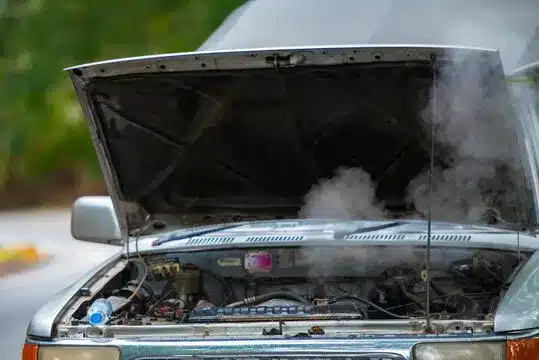
Quick answer: An engine overheats when the cooling system stops carrying heat away as fast as the engine makes it. The usual causes are low coolant from a leak, a stuck thermostat, a failing water pump, a blocked radiator or a cooling fan that quit. If the gauge climbs, pull over somewhere safe and shut the engine off. Our visual check is free.
The temperature gauge climbing is the symptom. The cause is somewhere in the system that moves coolant, and there are about nine things it can be.
Overheating rarely fixes itself. So the goal is to find the cause rather than keep topping up coolant.
What should I do if my car is overheating?
- Turn the AC off and the heater on full. It feels wrong on a hot day, but the heater core pulls heat out of the coolant and can buy you a few minutes.
- Pull over somewhere safe and shut the engine off. Every minute an engine runs hot is doing damage.
- Do not open the radiator cap while it’s hot. The system is pressurized and the coolant is well above boiling. Give it at least half an hour.
- Look underneath. Coolant on the ground tells you something useful before anyone touches the car.
- If it overheated badly, have it towed. Driving a mile to save a tow bill is a poor trade against a head gasket.
What causes a car to overheat?
Nine common causes, and they all produce the same symptom. That is why we test instead of guessing. Each one links to the page covering that repair:
- Low coolant or a leak: from the radiator, a hose, the water pump or the heater core. The most common cause, and the easiest to confirm.
- A failed thermostat: stuck closed, coolant never reaches the radiator at all. An inexpensive part that causes expensive damage.
- A blocked or corroded radiator: either clogged internally or packed with road debris on the outside.
- A failing water pump: if the pump isn’t moving coolant, nothing else in the system matters.
- A split or collapsing hose: hoses fail from the inside out and often look fine right up until they don’t.
- Cooling fan failure: the giveaway is a car that runs fine on the highway and climbs in traffic.
- Old coolant: coolant loses its corrosion protection with age, and that corrosion is what blocks radiators from the inside.
- A failed radiator cap: it holds system pressure, which raises coolant’s boiling point. A cheap part with an outsized job.
- Head gasket failure: combustion gases pushed into the cooling system. Usually a consequence of prolonged overheating rather than the original cause.
If you’re not sure where to start, our engine cooling system repair page covers how the whole system fits together.
Why does my car only overheat sometimes?
A car that overheats in traffic but is fine on the highway is telling you something specific. At speed, air is forced through the radiator whether the fan works or not. In stop-and-go traffic there’s no airflow except what the fan provides. So a dead fan shows up in traffic and hides on the freeway.
The reverse pattern points elsewhere. Running hot only at highway speed or towing usually means the system has lost capacity, from a partially blocked radiator or low coolant, and copes until you ask more of it. Overheating with the AC on points the same direction, because the AC condenser sits in front of the radiator and adds heat to everything behind it.
None of that is proof on its own, but it narrows the search considerably, and it’s worth telling us which pattern you’re seeing.
How do we find the cause of overheating?
The visual check is free. Bring it in and we’ll look at coolant level and condition, the radiator, hoses, the thermostat housing and whether anything is visibly leaking. That look costs you nothing and it often answers the question by itself.
When it needs more than a look, that’s real diagnostic time and it’s billable. We’ll tell you what it costs and get your approval first. Depending on the symptom that can mean a pressure test to find a leak you can’t see, thermostat testing, cooling fan diagnosis, radiator flow testing, or a chemical block test to check for combustion gases in the coolant.
Whatever we find is documented through our Digital Vehicle Inspection, with photographs and measurements, so you’re deciding from the same evidence we are. If you’d rather start with diagnosis than a specific repair, that’s what our cooling system diagnostics service is for.
Is the repair covered by a warranty?
Qualifying cooling system repairs at MotorCar Doctors are covered by a 36-month / 36,000-mile nationwide warranty on parts and labor, honored at participating shops across the country. Full terms are on our warranty page.
Bring It In
We’ve been sorting out cooling problems in Beaverton since 1995, with ASE-certified technicians, for drivers across Aloha, Tigard, Hillsboro, Cedar Hills and the rest of Washington County.
Find us at MotorCar Doctors Auto Repair, 13203 SW Canyon Rd, Ste C, Beaverton, Oregon 97005, open Monday through Friday, 8:00 AM to 5:00 PM. Call 503-626-4810 to book a time, or stop by and we’ll take a look at it.