

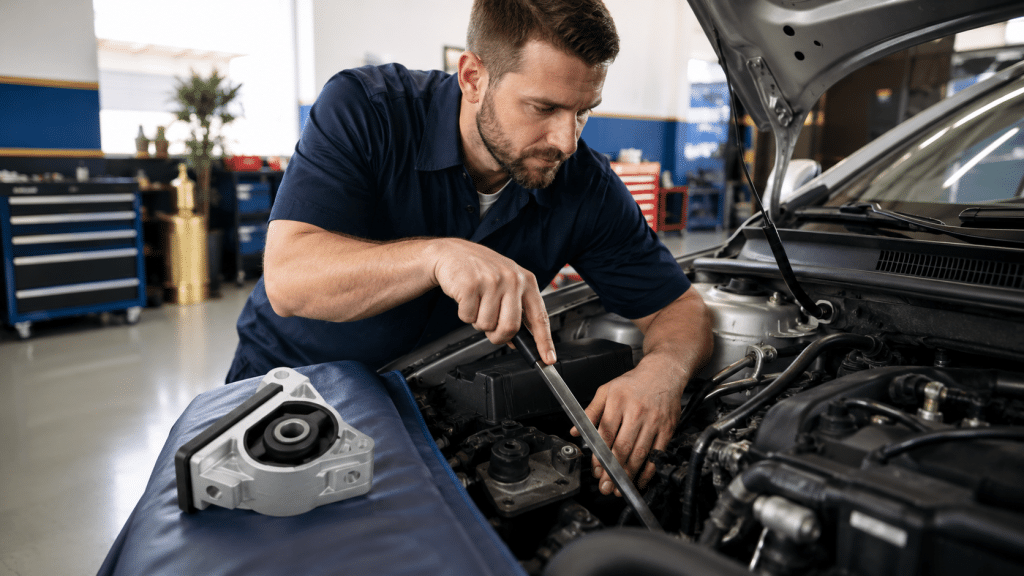
Motor mount replacement is often the answer to a vibration that feels far more expensive than it is. Motor and transmission mounts hold the engine and gearbox in place, and stop you feeling them. They’re rubber, sometimes fluid-filled, bolted between the engine or transmission and the frame. Their job is to carry a heavy, vibrating, torque-twisting lump of metal while passing as little of that as possible into the car you’re sitting in.
What a Failing Mount Feels Like
A failing mount usually shows up as vibration at idle or a clunk when you shift.
- Vibration through the floor, seat or steering wheel: usually worst at idle, and often noticeably better as soon as you’re moving.
- A clunk or thud on gear changes, pulling away, or lifting off the throttle: the engine shifting on a broken mount and hitting its travel limit.
- A shudder as you pull away from a stop, which is where mounts get mistaken for a clutch problem.
- Visible engine movement: a healthy engine rocks slightly when you blip the throttle. A failed mount lets it lurch.
- Noise over bumps, as the drivetrain moves independently of the body.

Why Mounts Are Worth Ruling Out First
This is the part worth knowing before anyone quotes you for something larger. Our diagnostic chart lists broken motor mounts and broken transmission mounts as causes of clutch chatter: a shudder as the clutch engages. From the driver’s seat that feels much like a clutch problem, and a clutch replacement is a substantially larger job than a mount. Mounts are also named as a cause of a car shaking while driving, alongside tyres, brakes and suspension. They’re quick to check and inexpensive relative to what they can imitate, which is exactly why they belong early in a diagnosis rather than late.Why Mounts Fail
- Age. The rubber hardens, cracks and eventually separates. It is a wear item on a long clock.
- Heat. Sitting in an engine bay for years does rubber no favours.
- Oil contamination. A leak above a mount will soften and destroy it far faster than age alone.
- Fluid loss. Some mounts are hydraulic: fluid-filled to damp vibration better than rubber can. When one leaks, it fails while often still looking intact.
- Load. Hard launches, towing and worn mounts elsewhere all put extra work through whichever mount is still doing its job.